People always think when people say Sea World, they think Murderers, Capturers, mean. Well, a fact to those people is Sea World's last Orca capture was 50 years back almost. Sea World also doesn't just use the animals to entertain humans, they actually teach natural wild behaviours and sometimes new things they can do in the wild. Sea World also has habitats for each animal so they feel right at home, and are enjoying their life.
Sea World feeds their orcas, and other marine animals daily and makes sure each one feels loved. The 9 Orcas of Sea World Orlando, FL, have their family all around, it's their pod. It's their life. People who say Sea World tourtures them, go and hang out behind the shows and tanks then say that. Everyday Sea World Orlando uses their "H.E.L.P.R.S." technique with each orca daily. H is for Husbandry, E is for Excersize, L is for Learn, P is for Playtime, R is for Rehearse, and S is for Shows.
Tilikum, or known as Tili, or Shamu, is the largest and oldest orca in captivity in history. Tilikum weighs approx. 12,000LBS and is past 30 years old. Tilikum plays the role of the passed away Shamu, who once represent Sea World. Tilikum has also had some bloodthirsty history, but no one is absolutely sure of the whole stories.
Before the stories, this message is off of Tilikum Wikipedia, and was not written by myself:
Tilikum measures 22.5 feet (6.9 m) long and weighs in at 12,300 pounds (5,600 kg), as of 2010. His pectoral fins are six and one half feet long, his flukes curl under, and his 6 feet (1.8 m)-tall dorsal fin is collapsed completely to his left side, and weighs close to 200 pounds (91 kg). He is the largest orca in captivity and also the most successful sire in captivity, with 13 offspring, 10 of which are still alive. In the Chinook Jargon of the Northwest, the name means "friends, relations, tribe, nation, common people.
Back to me saying the facts. Tilikum's first sired calf was born from Katina, and was named Taku. Taku was born September 9th, 1993. His latest born calf (unknown named) was burn from Katina again in 2010.
Tilikum measures 22.5 feet (6.9 m) long and weighs in at 12,300 pounds (5,600 kg), as of 2010. His pectoral fins are six and one half feet long, his flukes curl under, and his 6 feet (1.8 m)-tall dorsal fin is collapsed completely to his left side, and weighs close to 200 pounds (91 kg). He is the largest orca in captivity and also the most successful sire in captivity, with 13 offspring, 10 of which are still alive. In the Chinook Jargon of the Northwest, the name means "friends, relations, tribe, nation, common people.
Now, to Tililkum's three ACCIDENTS that are not all fully explained and solved. These will always remain a mystery (this is from Wikipedia)
While at Sealand, on February 21, 1991, Tilikum was involved in an incident which resulted in the death of a female trainer. The trainer slipped and fell into the tank with the whales. Tilikum, pregnant Haida II, and Nootka IV grabbed her in their mouths and tossed her to each other, presumably playing. The trainer subsequently drowned. The orcas had never had humans in the water with them before. Haida II and Nootka IV were protective of the newborn calf and aggressive towards Tilikum, who was forced into the small medical pool.
Second incident
Tilikum was at the scene of a death on July 6, 1999. A 27-year-old homeless male intruder was found floating naked in Tilikum’s pool; the cause of death was hypothermia.] He had visited SeaWorld the previous day, stayed after the park closed, and evaded security to enter the orca tank. Investigators determined that the man appeared to have bitten Tilikum. The man who drowned was later identified as Daniel Dukes.
Third incident
On February 24, 2010 Tilikum was involved in a third incident, when he killed Dawn Brancheau, a 40-year-old trainer with 16 years of experience at SeaWorld. The trainer was drowned following a popular 'Dine with Shamu' show as at least two dozen tourists looked on from above a whale tank and from an underwater viewing area. Employees used nets and threw food at the whale in an attempt to distract him.
Moving from pool to pool in the complex, they eventually captured Tilikum and released Ms Brancheau's body, before realizing that the whale still had her arm. A SeaWorld executive confirmed what witnesses saw, that Tilikum pulled the trainer into the water by her ponytail, possibly mistaking it for a fish or thinkig it was a toy. Brancheau's autopsy indicated death by drowning and blunt force trauma. The autopsy noted that her spinal cord was severed and she sustained fractures to her jawbone, ribs and to a cervical vertebra.
A representative for SeaWorld stated that the company intends for Tilikum to return to shows, but that a final decision will not be made until their review of procedures has been completed.
On August 23, 2010, the park was fined US$75,000 by the Occupational Safety and Health Administration(OSHA) for three safety violations, two directly related to Brancheau's death. SeaWorld issued a statement that called OSHA's findings "unfounded".
Scott Brancheau, widowed husband of the SeaWorld Orlando trainer Dawn Brancheau, has hired Chicago law firm O'Connor & Nakos that specializes in wrongful-death litigation to represent him.
Now, let's use Wikipedia to learn about the most famous female orca...
Katina!
Upon her capture, Katina was purchased by Marineland in Niagara Falls, Canada, where she was first named Kandu 6. She was shipped to the facility soon after. However, she did not spend much time there. Sometime between April and June of 1979, Katina was bought by SeaWorld. She was sent to their park in San Diego. In 1982, Katina was moved to the park in Ohio with another female named Kasatka, with whom she was captured in 1978. For two years, the two would perform in the Ohio park during the summer months and then be moved back to San Diego for the winter. Finally, in September or October of 1984, Katina was transferred to the SeaWorld in Orlando. She has remained there ever since.
[edit] Family members/breed
- Daughters: Kalina*, Katerina*, Unna, and Nalani
- Sons: Taku*, Ikaika and unnamed son (born Oct 2010)
- Granddaughters: Skyla and Nalani
- Grandsons: Keet, Keto, Tuar, and Trua
- Greatgrandchildren: Kalia and Halyn*
- Possible Relatives: Betty*
- Breed: 100% Icelandic
(Asterisk indicates a deceased relative)
Birth of Kalina
Katina became pregnant in early spring of 1984 at SeaWorld San Diego. She had mated with a male named Winston. Soon afterward, she was moved back to Sea World Ohio in Aurora, Ohio for the summer. While there, the trainers soon realized she was pregnant. Because of this, she was moved to Orlando in the end of the summer season. This is where she gave birth.
On September 26, 1985, Katina went into labor. A few hours later, she bore her first calf--a female, who was named Kalina. Although ten Orca calves had been born in captivity prior to Kalina, none of them had survived past a few weeks. This made Kalina the first Orca calf to be successfully born and raised in captivity, which made Katina the first successful mother. The success of the captive Orca breeding program began with Katina in 1985.
Katina's other calves and grandchildren
In early 1987, an adult male Orca named Kanduke arrived in Orlando. He and Katina soon mated. Katina bore her second calf on November 4, 1988. It was another female named Katerina. In early 1991, and at a very early age, Katerina was transferred out of Orlando. Katina would never see her daughter again. Katerina died on May 5, 1999 at SeaWorld San Antonio in Texas at 10.5 years of age.
A male named Tilikum came to SeaWorld in January of 1992. It wasn't long before Katina was pregnant again. She gave birth to her first son on September 9, 1993; the calf was named Taku. Just a few months prior to Taku's birth, Katina's first-born calf Kalina gave birth to her first calf, Keet, on February 2, 1993, thus making Katina a grandmother. Keet was born in SeaWorld San Antonio, where Kalina resided at the time.
Katina's next calf came on December 27, 1996. It was a female and she was named Unna. Her fifth calf was a male born on August 25, 2002; he would later be named Ikaika. Unna, Ikaika, and Taku were all fathered by Tilikum.
Katina gave birth to her sixth calf on September 18, 2006. The calf appears to be in good health and is now appearing in shows with Katina.[1] The calf is female and has been named Nalani. The father has said to be Katina's son, Taku.
Besides Keet, Katina has three other grandchildren all born to Kalina and two great-grandchildren. Kalina has three other calves: Keto (male; born 1995), Tuar (male; born 1999), and Skyla (female; born 2004). She has another grandchild who is sired by her Taku born to Takara named Trua. Keet, Kalina's oldest calf, has fathered two daughters of his own: Kalia (2004) and Halyn* (2005-2008), making Katina the first ever great-grandmother at SeaWorld.
Katina currently
Katina is about 34 years old and is healthy and doing well. Measuring about 16 feet 4 inches and weighing in at about 5,200 pounds, Katina is on the small side compared to most other females, but she is rather bulky. She is an excellent performer and is very reliable. She is one of their principal whales for performances and is used daily. Katina is generally very sweet-natured and patient and has never been involved in any known incidents with one of her handlers.
Being the matriarch of the Orcas, Katina is rather dominant. She can sometimes, although rarely, be stubborn and refuse to perform. When this happens, usually all of the other Orcas follow suit.
Katina only lives with two of her six calves (her latest one and Nalani) and one of her grandchildren (Trua). She is always with her calf, but was also with Takara and Trua quite often up until Takara was transferred to SeaWorld San Antonio. A new female named Kayla arrived in Orlando recently from SeaWorld San Antonio. She has been introduced to Katina, and the two have recently been spending time together. Seaworld announced on May 18, 2010 that Katina was pregnant again. She gave birth to a healthy calf at 7:28 pm on Saturday October 9th, 2010. The calf is approximately 350 pounds and 7 feet long. It was determined a boy on October 18 2010.
Below, is Katina doing a behaviour.
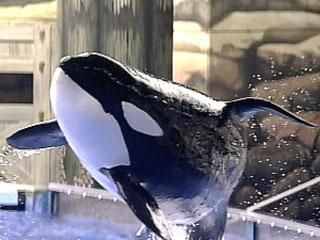
Below, is Tilikum jumping. A way to tell Tilikum apart from other whales is his size, and his dorsal fin, which is completely flopped over.

